
When You Don't Know What To Do Next
The framework I use to turn confusion into one clear next step.

Most people don’t need more advice.
They already have enough of it.
Books. Podcasts. Saved posts. YouTube videos. Half-finished courses.
Advice isn’t the problem.
The problem is that life rarely falls apart in a way that fits neatly into a list of instructions.
A difficult conversation. A relationship that feels strained. A career decision. Burnout. A season of uncertainty. A transition you didn’t ask for.
When you’re in the middle of something difficult, you usually don’t need more information.
You need clarity.
You need a way to think.
You need a process.
That’s why I built the Rebuild Operating Model.
Not because I had life figured out.
Because I didn’t.
Why I Created It
Over the last few years, I’ve rebuilt many parts of my life.
Some by choice.
Some because I had no choice.
I’ve navigated burnout, difficult decisions, uncertainty, family challenges, identity shifts, and the quiet pressure of trying to hold everything together while pretending I was fine.
What I discovered was surprisingly simple.
Most people are not stuck because they lack intelligence.
They’re stuck because they’re overwhelmed.
They’re carrying too many possibilities, too many fears, too many responsibilities, and too many stories about what might happen.
The result is confusion.
And confusion creates paralysis.
The Rebuild Operating Model was designed to break that cycle.
Not by solving your entire life.
By helping you identify one honest next step.
Because that’s usually all you need.
The Goal Is Not Perfection
The goal is clarity.
The goal is movement.
The goal is learning how to trust yourself again.
Most people try to solve everything at once.
The model does the opposite.
It takes a complicated situation and helps you see it clearly enough to move forward.
One situation.
One decision.
One conversation.
One next step.
That’s how rebuilding actually happens.
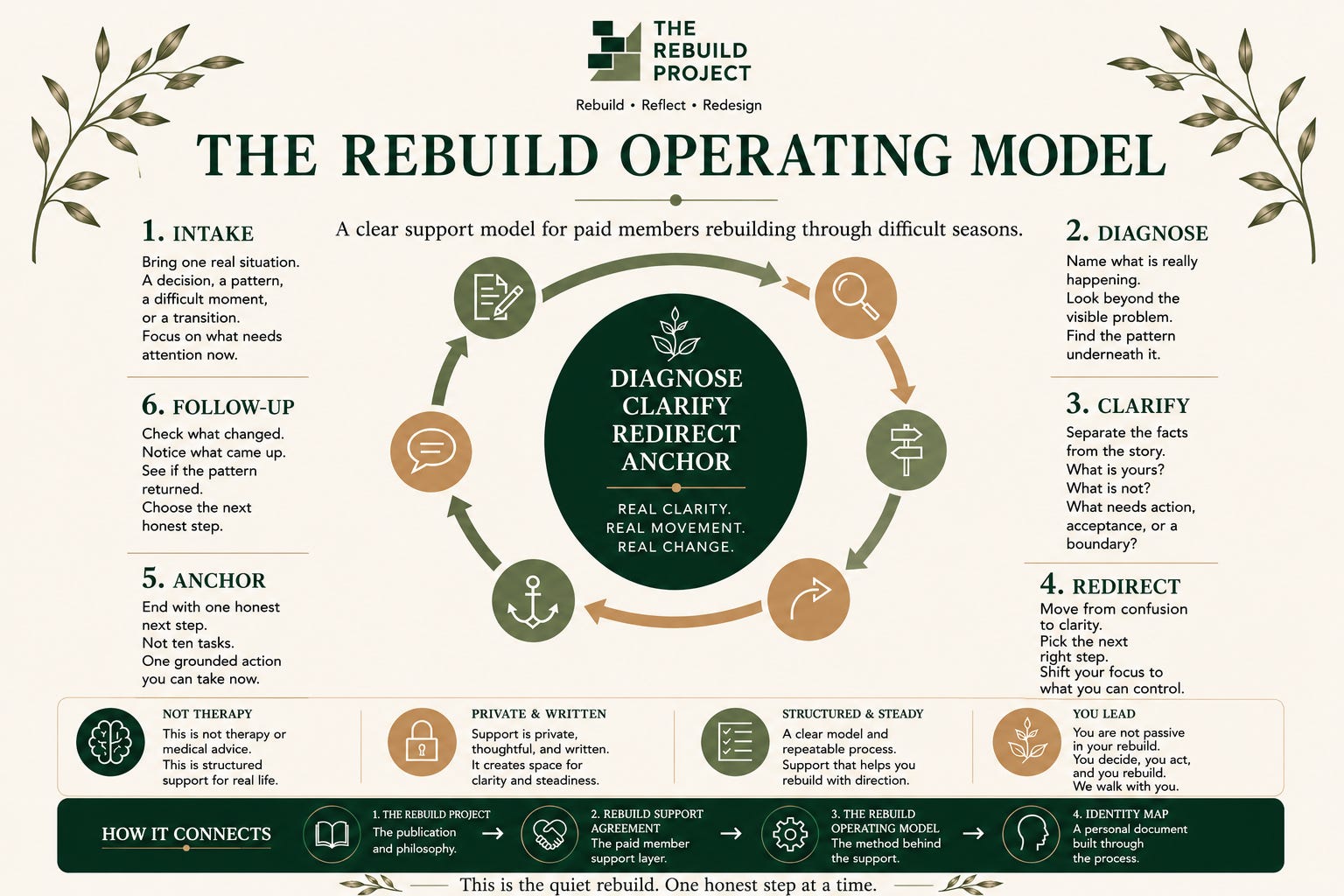
The Rebuild Operating Model
The model consists of six simple phases.
You can move through them in twenty minutes or over several days.
The pace doesn’t matter.
The process does.
1. Intake
What needs attention right now?
Not your whole life.
Not every problem.
One situation.
A decision you’re avoiding.
A pattern you keep repeating.
A conversation that keeps replaying in your mind.
A transition you’re struggling to navigate.
Bring one thing.
That’s enough.
Example
“I keep feeling frustrated every time I speak with my manager.”
That’s the situation.
No analysis yet.
Just honesty.
2. Diagnose
What is really happening?
Most problems have two layers.
The visible layer.
And the hidden layer.
The visible problem might be work.
The hidden problem might be fear.
The visible problem might be a relationship.
The hidden problem might be resentment.
The visible problem might be procrastination.
The hidden problem might be perfectionism.
Diagnosis means looking underneath the surface.
Example
“I thought I was frustrated with my manager.
What I was actually feeling was unappreciated.”
That changes everything.
3. Clarify
What is true?
What story am I telling myself?
This is often the most important step.
Most suffering comes from mixing facts with assumptions.
Facts are real.
Stories are interpretations.
Facts: My manager didn’t reply to my message.
Story: He doesn’t value my work.
Facts: My partner seemed quiet tonight.
Story: She’s angry with me.
Facts: I haven’t launched the project.
Story: I’m a failure.
When you separate facts from stories, clarity begins to emerge.
You stop reacting to assumptions.
You start responding to reality.
4. Redirect
What is the next right step?
Not the perfect plan.
Not the entire roadmap.
One action.
One conversation.
One boundary.
One question.
One decision.
Movement creates clarity.
Waiting for perfect clarity usually creates more waiting.
Example
Instead of rewriting an entire business strategy, send the email.
Instead of fixing the whole relationship, start the conversation.
Instead of planning the next five years, schedule tomorrow.
One step.
5. Anchor
What will help me stay aligned?
Most people have insights.
Few people create structures.
An anchor is a small practice that keeps you connected to what you’ve learned.
Simple.
Visible.
Repeatable.
Examples
Before saying yes, wait 24 hours.
Before reacting, take three breaths.
Before assuming, ask a question.
Before solving, clarify the problem.
Small anchors prevent old patterns from taking over.
6. Follow-Up
What changed?
This is where growth becomes visible.
What shifted?
What surprised you?
What worked?
What didn’t?
What will you do differently next time?
You don’t need a perfect outcome.
You need awareness.
The goal is not never repeating a pattern.
The goal is noticing it sooner.
That’s progress.
Why This Model Works
Because it doesn’t ask you to become someone else.
It helps you understand yourself.
It doesn’t promise transformation overnight.
It creates clarity today.
It doesn’t overwhelm you with ten steps.
It focuses on one.
Most people don’t need a new life.
They need a clear next move.
And then another.
And then another.
Eventually those small decisions become a different life.
How This Connects To Paid Membership
The Rebuild Operating Model is the method.
The Rebuild Support Agreement is the support layer built around it.
When you’re a paid member, you don’t have to process difficult situations alone.
You bring the situation.
We run the model together.
You receive perspective, clarity, and one honest next step.
Not generic advice.
Not motivational quotes.
Practical support applied to your real life.
What Paid Members Receive
Rebuild Support Agreement (RSA)
Private written support when you’re navigating:
• Difficult decisions
• Burnout
• Relationship challenges
• Career uncertainty
• Major life transitions
• Personal rebuilding seasons
The Rebuild Operating Model
A structured framework that helps turn confusion into clarity.
Your Identity Map
A living document built through the process.
It captures:
• Who you are
• What drives you
• What matters most
• Your recurring patterns
• Your strengths
• Your blind spots
• Who you’re becoming
Over time it becomes a personal operating manual for your life.
Response Commitments
Structured response windows based on your membership level.
Reliable support when you need perspective.
Clarity And Direction
Every interaction ends with:
• Clear perspective
• Practical insight
• One honest next step
You Don’t Have To Rebuild Alone
Most people spend years trying to think their way through difficult seasons by themselves.
Sometimes what you need isn’t another book.
Sometimes you need structure.
A process.
A second perspective.
A reliable place to untangle what feels tangled.
That’s what this work is for.
Not to tell you what to do.
To help you see clearly enough to decide for yourself.
One honest step at a time.
The quiet rebuild begins there.
Activate Your Rebuild Support Agreement
✦ Private written support
✦ The Rebuild Operating Model
✦ Your evolving Identity Map
✦ Clarity, direction, and one honest next step
You don’t have to carry everything alone.
https://therebuildproject.co
This is the quiet rebuild.
That's neat. I love that you created a visual diagram. Those are super helpful! I love that you mentioned that its goal is for clarity, not to solve all your life problems. Well said!
Very informative. Thank you.