

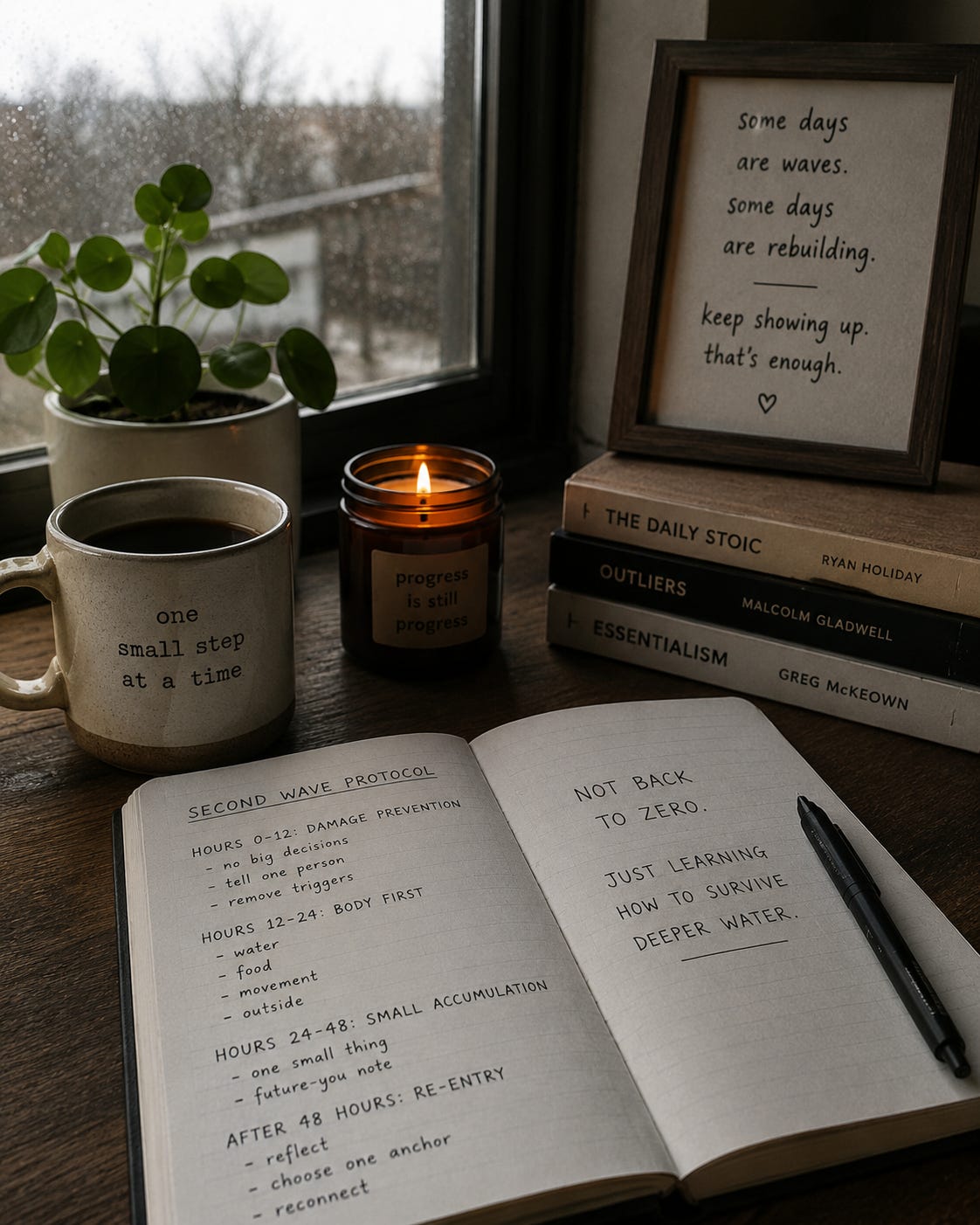
I thought I was past this.
I had written the essays.
Built the habits.
Started feeling like myself again.
I was sleeping better. Writing more. Showing up for my son without feeling emotionally absent all the time.
Then one Tuesday, I woke up and couldn’t move.
Not physically.
Emotionally.
The fog was back.
The heaviness.
The urge to disappear.
And the voice returned immediately:
See? Nothing changed. You’re just better at pretending now.
I spiraled for two days.
Canceled a clarity chat.
Stopped writing.
Scrolled my phone for hours.
Snapped at my wife over something insignificant.
By Thursday night, I was lying on the floor of my office staring at the ceiling, convinced I had failed.
Not just at the rebuild.
At everything.
That was my second wave.
And at the time, I thought falling back meant everything before it was fake.
Now I know differently.
If you’ve ever made progress and then suddenly felt yourself collapse again, this is for you.
What a Second Wave Actually Is
A second wave is not a return to zero.
It feels like it.
But it isn’t.
Think about an actual wave.
Before it crashes forward, it pulls back.
That pullback feels like loss.
Like regression.
Like something is being taken from you.
But the wave is gathering force.
That’s what most people misunderstand about setbacks.
A setback is not a reset.
It’s a reorganization.
Your mind and body are integrating what you’ve learned. Old defenses are loosening. New patterns are trying to form.
That doesn’t make the experience pleasant.
But it changes what you do next.
Because panic makes the wave worse.
Recognition changes it.
The Three Mistakes I Made
Mistake 1: I isolated
I disappeared.
Canceled the clarity chat.
Stopped replying to messages.
Stopped commenting.
Stopped talking.
I thought I needed to “figure myself out” before reconnecting.
That only made the spiral louder.
What works better:
Send one simple message.
Not an explanation.
Not a dramatic confession.
Just honesty.
“Having a rough day. Won’t be very responsive. Back soon.”
That one sentence keeps you connected to reality.
Mistake 2: I catastrophized
I treated one bad week like proof that nothing had changed.
I ignored every sign of progress and focused entirely on the collapse.
That’s what the brain does when fear takes over.
It edits your entire life down to one painful moment.
What helps instead:
Write down one piece of evidence that your progress is real.
A calm morning with your kid.
A message from someone you helped.
A version of yourself six months ago who wouldn’t have handled this half as well.
Progress is still progress, even when you temporarily lose access to the feeling of it.
Mistake 3: I tried to think my way out
This one trapped me the longest.
I analyzed everything.
Why do I feel this way?
What triggered this?
What’s wrong with me?
What’s the root issue?
I turned the second wave into another intellectual project.
That only kept me stuck in my head.
What works better:
One physical action.
A walk.
A shower.
Stretching for two minutes.
Standing outside in cold air.
Not to fix yourself.
Just to remind your nervous system:
I’m still here.
The 48-Hour Protocol
I’ve used this dozens of times now.
It doesn’t stop the second wave.
It helps you move through it without drowning inside it.
Hours 0–12: Damage Prevention
Do not make major decisions.
Do not send emotional messages.
Do not quit your job.
Do not end relationships.
Do not rewrite your entire life story at 1am.
Reduce stimulation immediately.
Turn off notifications.
Put distance between yourself and endless input.
Then tell one person the truth.
Simple version:
“I’m in a rough patch. Don’t need solutions. Just wanted someone to know.”
That sentence matters more than you think.
Hours 12–24: Body First
Your body needs safety before your mind can find clarity.
Drink water.
Eat something real.
Take a shower.
Go outside.
Even five minutes helps.
Especially when you don’t feel like it.
The goal is not optimization.
The goal is reconnection.
Hours 24–48: Small Accumulation
Do one small thing.
Not ten.
One.
Reply to one message.
Wash one dish.
Write one paragraph.
Fold one shirt.
Then stop.
You do not need to “catch up.”
At the end of the day, write down one thing future you will thank you for.
Even if it’s tiny.
Even if it’s just:
“I got out of bed.”
That still counts.
Re-Entry
After 48 hours, look back gently.
Not critically.
Ask:
What triggered the wave?
What helped?
What made it worse?
Then choose one anchor for the next week.
Not a life overhaul.
Just one stabilizing thing.
A morning walk.
No phone before coffee.
An evening check-in.
A boundary you protect.
Small anchors prevent large drifts.
A Real Example
The first time this happened, I handled it terribly.
But the next wave was different.
I told my wife:
“I’m struggling today. I don’t need fixing. I just need to be quiet for a bit.”
She nodded.
No solutions.
No pressure.
Then I walked to the corner store and bought a banana.
I ate it standing outside on the sidewalk.
Not because bananas cure emotional collapse.
Because it was something real.
Something physical.
Something small enough to do.
Later that night, I wrote one sentence in my phone.
Today I showed up by not hiding.
That sentence changed something in me.
The wave didn’t disappear.
But I stopped drowning in it.
A Final Word
You will have second waves.
That does not mean you failed.
It means the rebuild is real.
The goal is not to never fall back.
The goal is to recognize the wave earlier.
To respond with care instead of panic.
To recover faster each time.
You are not back at zero.
You are just learning how to survive deeper water.
Some waves are not here to destroy you.
They’re here to show you what still needs care.
This is the quiet rebuild.
Not ready for a subscription? I also offer a quiet 30‑minute one‑on‑one chat for $1. No fixing. Just listening.
👉 Book a $1 chat here:
https://donate.stripe.com/dRm14n5nQ3SB6GG4nBcEw01
👉Free clarity chat (15 minutes, no cost)
https://calendly.com/therebuildproject/clarity-chat
I felt like you were speaking directly to me. It's amazing and sad that so many of us are feeling this way. Keep on writing, I'll be here to read it.
I have had so many moments of falling back and I have learnt the hard way that it was just building my muscle for dealing with these waves with patience, love and action - even a small one. Thank you for sharing this powerful insight.